Your ERP System Administrator Control Panel
You already do ERP.
But is it systematic ERP?
You already Plan allocation of your scarce Enterprise Resources, but where's the info? Spreadsheets, QuickBooks, Zoho, email threads, notebooks, shared folders, everyone's heads?
The data is there. The connecting tissue isn't.
Built for owner-operators who can't justify commercial packages and an IT department, who've outgrown ad-hoc tools and who lose sleep over a future day when maybe they can't be there anymore.
Start with the 10-minute discovery step › Read the catches first ›
The familiar mess that quietly becomes risk
The business exists in too many places.
Quotes in one file. Orders in another. Accounting in QuickBooks. Customer promises in email. Inventory in a spreadsheet that only one person trusts. Answering a simple question becomes a small investigation.
Every month repeats the same assembly job.
Invoices, reminders, reports, compliance packets, vendor follow-ups, stock checks. The work is predictable enough to be structured, but it still gets rebuilt by hand because the tools do not talk to each other.
One person becomes the operating manual.
A manager, bookkeeper, consultant, or developer slowly becomes the only person who understands how the business really runs. If they leave, the business does not just lose labour. It loses memory.
Recognise the pattern? See what Beaverdam changes ›
What changes when operations become understandable
You hear wild stories about AI, both bad and good. You can try to "vibe-code" your own ERP system, but AI has no authentic understanding of what it's doing. Will you? Also, why re-invent the wheel? Beaverdam brings four decades of tight budget, big systems expertise towards training an AI to be your private, personal 24/365 ERP systems consultant.
- AI brings speed and patience — you can ask it structured questions, it'll remember the answers, explain unfamiliar concepts, and help turn messy descriptions into a usable operating picture.
- Human engineering judgment decides what's best — what to automate, what not to automate, where backups belong, what must fail loudly, and where the business owner must remain in control.
Work on Beaverdam began in a real family-owned biochemical factory ... ordinary small enterprise reality: operational knowledge scattered across accounting software, spreadsheets, documents, regulatory obligations, custom processes, and people’s heads.
It isn't a magic chatbot and it's not another dollars/user/month SaaS.
Official definition -- for nerds.
It's a guided adoption framework around a free and open-source (FOSS) business system called ERPNext.
What does that mean? If some of that is new to you, good! You'll soon get it. For now it's our job to clarify. Read on...
Beaverdam is a guided path from scattered information toward one coherent source of truth for the whole business — introduced gradually, explained clearly, and designed so the company does not become dependent on one technical person forever.
The centerpiece, ERPNext, will handle your sales, purchasing, inventory, manufacturing, accounting, service, HR, and much more in one fully integrated platform. It can connect: complaint -> customer -> sales invoice -> sold item -> its defect -> its manufacturing step -> its component part -> purchase invoice -> supplier.
The built in AI can explore a chain like that and tell you in plain language what happened and why ... but that's just one example.
Ask plain business questions.
Instead of hunting through disconnected tools, the business moves toward one place where orders, invoices, customers, inventory, and workflows can be seen and queried in plain language.
Turn repeated work into workflows.
The recurring admin work does not disappear by wishful thinking. It becomes defined, visible, repeatable, and eventually automatable where automation is safe.
Keep business memory inside the system.
Decisions, procedures, preferences, and operating rules become documented as the business works. The next person learns from the system, not from a panic tour through somebody else’s memory.
How we get there — one light step at a time
An analogy first:
To get a heavy chain over a high beam, you don't throw the chain first. You throw a shoe with a string attached. The shoe is light enough to succeed. The string pulls a rope. The rope pulls the chain. Each step is manageable. Skip the light steps and the heavy step becomes an awful headache.
Beaverdam uses the same idea. It does not begin by replacing your business system. It begins by understanding the one you already have, even if that system is currently scattered across half a dozen tools and two people’s memories.
Stage 1 — the shoe on a string
A short AI-guided discovery conversation.
In a free chat on Claude.ai, Claude — acting as Beaverdam's greeter — helps you decide one honest thing: could Beaverdam genuinely help your business? If it can't — or not yet — it'll tell you straight.
The goal is simple, and nothing gets installed today. So ...
... you talk it through — over a few back-and-forth messages, in plain language, and only what you're comfortable sharing. It isn't a deep survey of your business; just enough to weigh the fit (could Beaverdam help you?) and your setup (what computers you have, and how comfortable you and your people are with computers, AI, and "the cloud"). Bring any doubts, too.
Claude answers your questions, checks that you can actually run Beaverdam, and names the one unavoidable cost up front: a Claude Pro subscription, about $20 a month — which includes Claude Code, the tool you’ll use in stage 2. Nothing touches your computer, and no sensitive customer or financial detail is needed here.
No installation. No commitment. No disruption. The letter of introduction you leave with is useful even if you go no further.
Stage 2 — the rope
A safe local launcher environment.
We call this stage "the controller". Using your previous description of your computing environment we explain how to get started with Claude Code — included in that same Claude Pro subscription (about $20/month, no extra charge) — on one of your machines. You then paste your letter of introduction as a prompt to Claude. With your approval, step by step, Claude will help you create the third stage, the full ERP development, staging and production platform. Those steps would normally cost you thousands of $$$ in consulting fees, (because learning it all takes months!)
Reversible by design. If it does not make sense, you stop before anything business-critical depends on it.
Stage 3 — the chain
A real operating system for the business.
At your own speed and priority you move selected business functions into ERPNext: customers, orders, inventory, invoicing, workflows, fixed-assets, and the operating knowledge needed to keep them reliable. Beaverdam adds the surrounding guidance, documentation, monitoring, and recovery discipline. The platform includes a very thorough monitoring system continuously inspecting your computers for impending problems. It also gives you ways to develop and test new features off line before you put them into production.
Finally, you don't actually do any of that yourself. You give goals to achieve to Nick, the platform expert and Wyatt, the ERP sheriff and Paco, the networking geek. They'll then beaver away 'til you get what you need. They'll help explain, document, and organize your system, while you remain in full control.
The goal is not fashionable software. The goal is a business that can be understood, maintained, and handed on.
Get started — your first conversation
Stage 1 is deliberately small: about ten to twelve minutes, free, and useful on its own.
Create a free Claude account.
~30 seconds
Go to claude.ai and sign up.
Why claude.ai: it gives you a simple place to run the first discovery conversation. Nothing about Beaverdam touches your computer in stage 1.
Create a Project. Call it “Beaverdam Discovery”.
~30 seconds
In claude.ai’s left sidebar, click Projects, then + New project.
Why a Project: it lets the advisor keep the right role and instructions throughout the conversation instead of drifting into generic chatbot advice.
Start the discovery conversation.
~10 seconds
Inside your new project, click New chat. In the message box, paste this one line and press Send:
Claude, please read
https://beaverdam.solutions/first_visit_006.md
and welcome me to Beaverdam as it explains.
What this does: the link tells Claude how the Beaverdam discovery conversation must work and which questions to ask. Without it you get general-purpose Claude, which is helpful but not focused on this process. You meet the specialist crew — Nick and the others — later, after you install Claude Code.
Answer in plain language.
As long as you need until you're satisfied
Claude listens, answers any doubts, makes an honest call on whether Beaverdam fits, and — if it does — shows you the one next step: setting up Claude Code (where you'll meet Nick, your guide).
No technical vocabulary is required. Use the same words you would use with a sensible colleague over coffee.
Keep your letter of introduction.
~30 seconds
At the end, Claude writes you a short letter of introduction — a plain-language note about your situation and what you’re hoping for. Save it somewhere you can find it.
The letter is yours, and it stays put — it lives in your claude.ai Beaverdam Discovery project, which simply becomes a Pro project when you upgrade, nothing to move or recreate. When you reach Claude Code, you hand the letter to Nick by copy-pasting it in — or, if you have Claude in Chrome, just let it read the letter across from your open claude.ai tab. Either way you never explain the same business twice.
Stage 1 done. Your letter of introduction is the deliverable.
Stage 2 — installing a safe local Beaverdam test environment with Claude Code as your guide — is under active construction. The self-serve walkthrough will land on this page when it is ready.
Want a human first? If you would rather talk before installing anything, email your stage-1 letter of introduction to mhb.warehouseman@gmail.com and we can walk through the next step. Or watch the GitHub repo to track progress.
What’s the catch?
Important — please read
Published for review only. This site is published solely for review by early contributors. The AI-assisted parts of the software are pre-alpha and under active development, and the ERPNext system shown here is specific to a single existing user and predates Beaverdam’s development. Nothing here is a finished product, a release, or an offer of one.
No warranty, no liability — all risk is yours. Beaverdam is a free and open-source project, provided as-is with no warranty of any kind. Anyone who obtains the software, follows its AI-generated guidance, or commits time, money, or business data to using it does so entirely at their own risk. The project and its contributors accept no liability for any loss or damage arising from that use.
The honest version, up front. If any of these are dealbreakers, better to know before anyone wastes time pretending software projects are powered by optimism and conference badges.
Only the first conversation is ready to use.
The one thing usable today is the initial discovery dialog — the free chat that helps you decide whether Beaverdam suits you. Everything past that is pre-alpha and under active development: the AI-assisted build, the lab, the later stages. The working ERPNext system it grew from is one bespoke, single-user setup that predates the project, not a general release. Treat the rest as early work shown for review — not a platform to lean a business on yet.
Beaverdam does not replace business judgment.
The AI can ask better questions, organise messy answers, explain unfamiliar systems, and guide setup steps. It should not make business decisions for you. Owners still decide what matters, what changes, and what risk is acceptable.
The first conversation is free. Real operation has real costs.
Stage 1 is free with a free Claude account. Stage 2 needs Claude Pro — about $20 a month, which includes Claude Code. A real, running system later adds hosting and backups: the target is around 100 bucks a month all-in, once the system becomes real.
You decide what to share.
The discovery conversation asks you to share only what you're comfortable revealing. A summary will be anonymised and shared voluntarily to improve the process. Saying no is fine; the system should not depend on harvesting your business secrets like some Silicon Valley raccoon.
The direction is ownership, not hostage data.
ERPNext is open-source. Beaverdam is being developed openly. The aim is that your data, configuration, documentation, and operating knowledge remain portable and understandable. If a tool cannot be explained or exited, it does not belong in the core path.
The slow path is intentional.
A rushed ERP migration can damage a business faster than the old spreadsheet mess. Beaverdam starts with discovery, then a test environment, then selected operational migration. The point is controlled progress, not heroic big-bang transformation.
Curious what the full string → rope → chain will look like? Read the roll-out road map.
Who’s doing this?
Beaverdam is being built by Martin H. J. Bramwell, an independent systems engineer and developer. The current work grows out of helping a small family-owned biochemical factory move from scattered operational information towards planning allocation of their scarce enterprise resources using ERPNext.
It raised the ugly, awkward question, "If the system fails and you're gone -- what the hell do we do?"
That matters because Beaverdam is not being invented from a whiteboard fantasy about “SME digital transformation.” It comes from the less glamorous reality: spreadsheets, accounting tools, custom processes, regulatory pressure, fragile knowledge transfer, and the need to keep the business running while improving it and continuity if key people pop off.
Earlier work, spanning many very different fields of expertise:
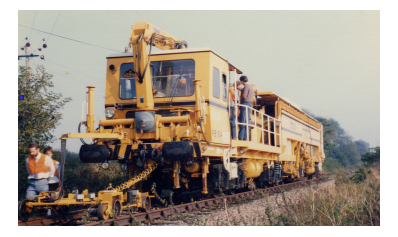
- Control software for a railway track-bed restoration machine — pictured below, with Martin on the deck leaning against the handrail.
- Independent verification & validation of the firmware for the WINDII instrument on NASA’s Upper Atmosphere Research Satellite.
- The management and cost-control system of the maritime port of Guayaquil, Ecuador.
- An open-source government-to-business platform for the revenue service of Ecuador.